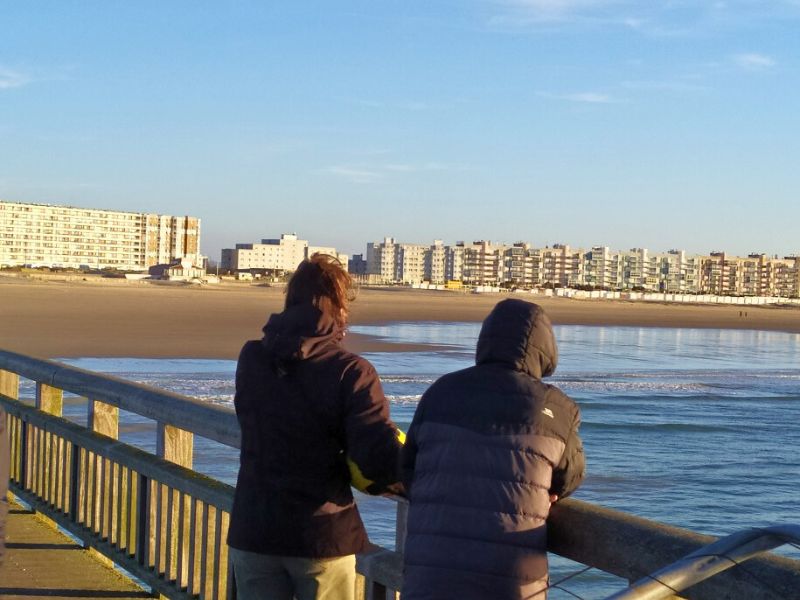
Edi stopped looking at the sea

Edi felt as if in a cage, Edi was as if trapped for a long time in a no-man’s land: in front of him an arm of the sea, not even that wide, with the English shore that, on the few clear days, seems close enough to touch. And yet to travel those few nautical miles costs a lot of money and is so scary, because the beach to which one lands is really the last: beyond there is nothing more, beyond there is no other north to dream of.
Before him is the sea, then, and behind him is a Europe that seems to want to know nothing about him. Yet, if only asked, Edi has many talents and can speak the languages of the world: he has very good English, he understands French, although he is shy to speak it, and he knows the language of the Persians and that of the Indians, he gets along well with the Arabs, and then there is his mother tongue, Amharic: an ancient language with its own alphabet made up of signs so mysterious to us. Edi is Ethiopian, but when asked he says so with a half-smile as if to suggest that this is not too important to him.
Of his homeland he loves the music, so steeped in reggae and dub rhythms. Few know it but the green, yellow and red-colored flag often associated with the world of reggae music is not that of Jamaica, but that of Ethiopia.The reason why is a long story of ancient exchanges, spirituality, dreams and the right ideas entrusted to the wrong people, and it is another story anyway…
Edi has all the air of a reggae singer, with a cap perpetually lowered on his head, a thick frizzy beard, and a short, lithe physique. He loves animated films, Edi, and is a great connoisseur of them. On the wall of Maison Effata’s hall is a very funny pink mouse with big ears, drawn by him, which immediately puts one in a good mood when looking at it.
Search France for a place for him
When Edi entered the house, his self-confidence trampled it with his own heels with each heavy step. In the house he did not encounter a miracle, but simply some listening, recognition, and a chance to show his skills: the same organization that had referred him to us offered him to become a volunteer worker, and it was heartwarming to see with what enthusiasm he left the house to go to his first shift on duty. He was ready two hours early and I suspect he did not sleep because of the excitement.

He is now a figurehead for all the new house guests and beyond, since he is the one who comes to tell me off if I’m late getting to the table when dinner is ready. On weekends he also helps other humanitarian organizations in the area, “i’m a business man, now,” he says with a laugh. He has decided to give the country that is giving him a small chance, decided to stop looking out to sea and look to France for a place for him.
This also happens here at the Northern Pass, and he is certainly not the only one Edi is, in fact, to be honest, Edi is certainly not his real name. If you want to know what his real name is, you will have to come and find him here in Calais and ask him: he will probably give you a half-smile as if to suggest that it is not too big a deal.